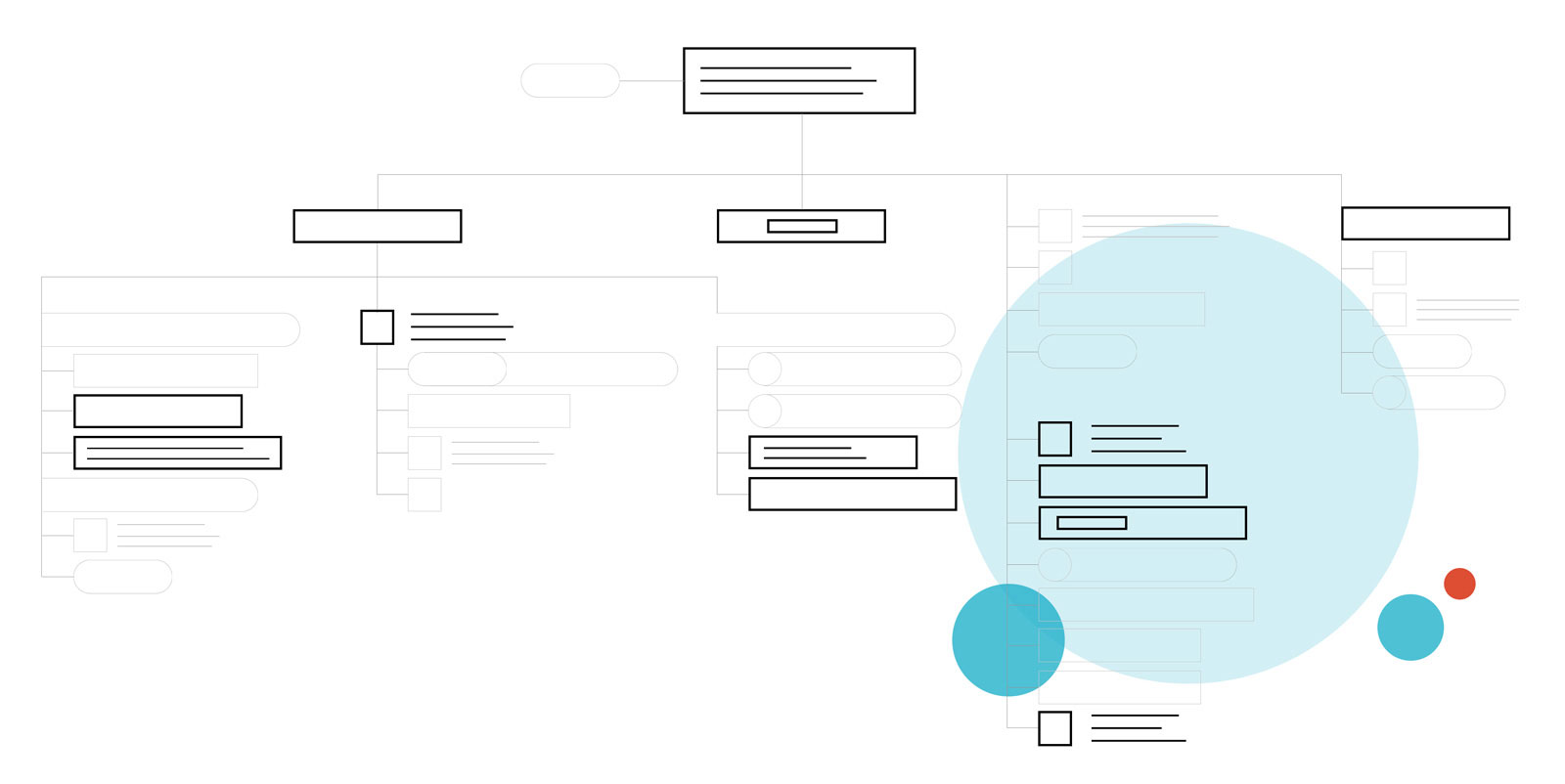

One of the main rules of information architecture is keeping your choice limited. Reducing complex content and restructuring it into something more accessible is crucial for successful communication. Information architecture can help in gaining new, regular, visitors. No more misled users or lost chances.
Information Architecture (IA, note: not AI) assumes that information requires structure. Particular information can be assimilated, if it is situated within comprehensible context and it is presented in a meaningful manner. Not only today’s Internet, but also real world is characterised by excess. Information – data relating to things, people, events, etc. – would be only chaos of stimuli, if there wouldn’t be any organisation of all that content into ordered structure.
Just as a brain organises stimuli flowing from the senses, so does an IA while it organises chaos of various data into a comprehensible whole. Readable organisation of content, categorisation (where taxonomy comes in) and labeling are therefore required. And just as house requires an architect who will design it for its inhabitants, so does information requires somebody competent, who can present it to reader, user and client.
IA is a science discipline, like librarianship or ergonomics. However it may look as always important, it seems that today it’s even more necessary as more content appears in the Internet; and as more varied and abstract it becomes. Indeed, financing of IA of major corporation and institutions steadily grows, and demand for IA was long ago recognised by the biggest sharks in the IT sector, like Amazon, Twitter or Google.
IA can help not only create mere site maps, simplify complex content, categorise it and place it into a hierarchy of information, but also give it more meaningful names, create metadata (eg. tags or hashtags) and introduce other techniques, which allows for more integration and coherence of the whole content.
IA is a discipline, which began much earlier than Internet, but which in the Internet found perhaps its biggest utilisation. Foundations, on which IA designers work upon comes from the librarianship (organising various books into branches and creating organised catalogue system, which allows easy searching), but IA as a standalone discipline was established in 1970 r. The founder is widely recognised as Richard Saul Wurman.
Due to its orientation towards user, its knowledge and ability to comprehend information (cognition and cognitive psychology) it is closely related to User Experience (UX) and it is to a greater or lesser extent – consciously or not – used by all web designers.
In Desta Design we strive to utilise acquired knowledge and experience relating to IA both in minor web and print design, as well as in design of major web applications, which offer wide array of products, services and information to its users and clients.
